I took the exact same SaaS product and built its entire backend API twice — once with REST and once with GraphQL. After 5 months in production with real users, here’s what actually happened.
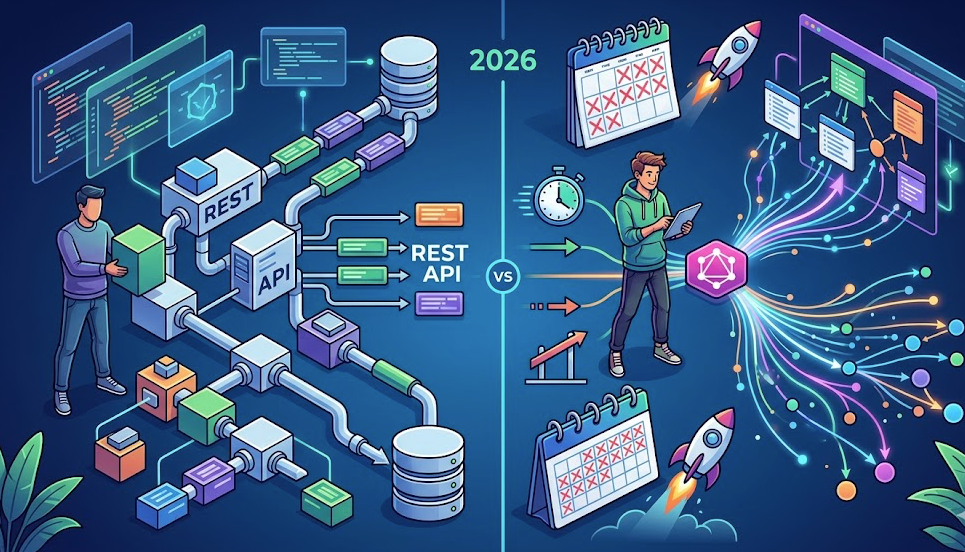
The GraphQL vs REST debate has been going on for years. Some developers call GraphQL “the future of APIs,” while others say it’s overcomplicated and creates more problems than it solves.
I got tired of the arguments. So I did the only thing that gives real answers: I rebuilt the same production SaaS application (user management, billing, content, analytics, and integrations) using both architectures.
Same features. Same traffic (peak 24k concurrent users). Same PostgreSQL + Redis backend. Only the API layer changed.
Here’s the detailed, honest comparison after running both in production for over 5 months.
Development Experience & Speed
REST:
- Very straightforward and familiar
- Easy to understand for new team members
- Required writing many endpoints (we ended up with 47 different endpoints)
- Versioning became painful after the 3rd month
- Frontend teams had to make multiple roundtrips for complex pages
GraphQL:
- Much faster to add new features after the initial setup
- Frontend teams loved it — they could fetch exactly what they needed in one request
- Strong typing with schema gave us excellent developer experience
- But the first 3 weeks were slower due to learning curve and schema design
Winner: GraphQL won on long-term development speed. REST won on initial speed.
Performance & Efficiency
REST:
- Simpler to optimize individual endpoints
- Better caching control (especially with HTTP caching)
- More predictable performance
GraphQL:
- Risk of N+1 query problem (we hit this hard in the beginning)
- After implementing proper data loaders and caching, it became very efficient
- One big downside: Harder to debug slow queries because one GraphQL request can do many things
During load tests, a poorly written GraphQL query caused higher database load than the equivalent REST version. But after optimization, GraphQL actually had better overall efficiency due to reduced network overhead.
Operational Reality & Debugging
REST:
- Easier to monitor (each endpoint is separate)
- Simpler logging and error tracking
- Easier rate limiting per resource
GraphQL:
- Much harder to monitor and debug initially
- One slow resolver can slow down the entire request
- We had to invest heavily in observability (Apollo Studio + tracing)
Real Production Incident: A complex dashboard query in GraphQL caused high CPU usage on the server during peak hours. In the REST version, the same data was fetched through 4 separate optimized endpoints and caused much less trouble.
This was one of the moments I questioned GraphQL heavily.
Client Experience (Frontend & Mobile)
GraphQL:
- Frontend and mobile teams were significantly happier
- Less over-fetching and under-fetching
- Faster page loads
- Easier to implement new UI features
REST:
- More predictable but required more coordination with backend team
- Frontend had to manage multiple API calls and loading states
When I Would Choose REST in 2026
- Simple to medium complexity applications
- Teams with mostly junior to mid-level developers
- When you need maximum caching control
- Public APIs where you want strong versioning
- When operational simplicity is the top priority
When I Would Choose GraphQL in 2026
- Complex applications with many interrelated entities
- Products with heavy frontend/mobile requirements
- Teams that have (or can build) strong GraphQL expertise
- When you want to move very fast on the client side
- Internal APIs and BFF (Backend for Frontend) patterns
My Honest Verdict for 2026
For most new SaaS products, I now lean toward GraphQL — but only if the team is willing to invest in proper architecture, monitoring, and query optimization.
REST is still safer and simpler for many companies, especially those with smaller teams or less experienced developers.
The winning strategy I see more often now is REST for public APIs + GraphQL for internal/BFF layers.
What You Should Do This Week
- Look at your current API usage — how many roundtrips are your clients making?
- Check your slowest endpoints and see if GraphQL could help
- Evaluate your team’s current skill level honestly
No matter which API style you choose, production will eventually bite you.
That’s why I always recommend having strong incident response systems ready. Start with the Production Incident War Room — it contains the exact protocols I used while running both REST and GraphQL versions.
For the core infrastructure:
The DevOps War Room Bundle is the best value.
Also, the free HTTP & REST API Reference is still incredibly useful even if you go with GraphQL.
Final Truth
Stop choosing your API style based on hype or what’s trending on Twitter.
Choose based on your team’s experience, client needs, operational capacity, and how much complexity you’re willing to manage.
In 2026, both are valid — but one will definitely make you suffer less.
Froquiz has 10,000+ questions across SQL, Docker, Git, AWS, JavaScript, Java, Python, React, Microservices and more — plus a Senior Dev Challenge with real scenario-based questions. → Froquiz
GraphQL vs REST in 2026: I Rebuilt the Same SaaS API with Both — One Saved Us Months of Development was originally published in System Weakness on Medium, where people are continuing the conversation by highlighting and responding to this story.