When the very system designed to monitor your application becomes the vector that takes it down.
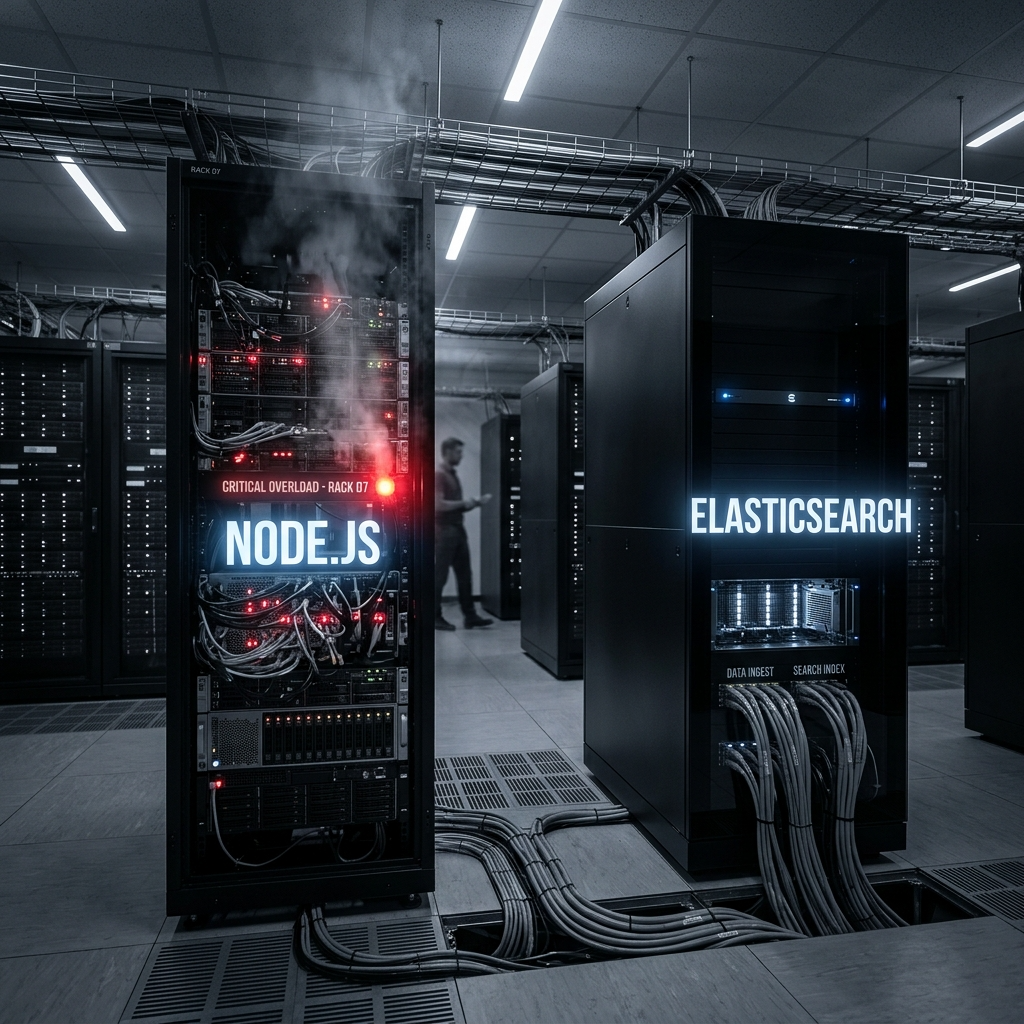
In the world of cybersecurity, we obsess over SQL injections, XSS, and broken authentication. But there is a silent, often-overlooked architectural flaw lurking in thousands of production Node.js microservices: Synchronous Logging.
Developers inherently trust `console.log()` or standard file streams (`fs.createWriteStream`). But what happens when an attacker realizes that forcing your application to write logs is the easiest way to perform a Denial of Service (DoS)?
In this article, we’ll explore how attackers weaponize logging mechanisms to cause Disk Exhaustion and Event Loop blocking in Node.js, and how implementing an asynchronous ELK (Elasticsearch, Logstash, Kibana) architecture mitigates this threat entirely.
The Attack Vector: Anatomy of a Log-Based DoS
Node.js is famously single-threaded, relying on an Event Loop to handle massive concurrent connections asynchronously. However, certain operations — specifically heavy I/O operations like writing to standard output (stdout) or a local disk — can become bottlenecks under extreme load.
When an application logs every incoming HTTP request (e.g., using a basic Morgan or Winston setup writing directly to a file), an attacker can exploit this.
The Attack Flow
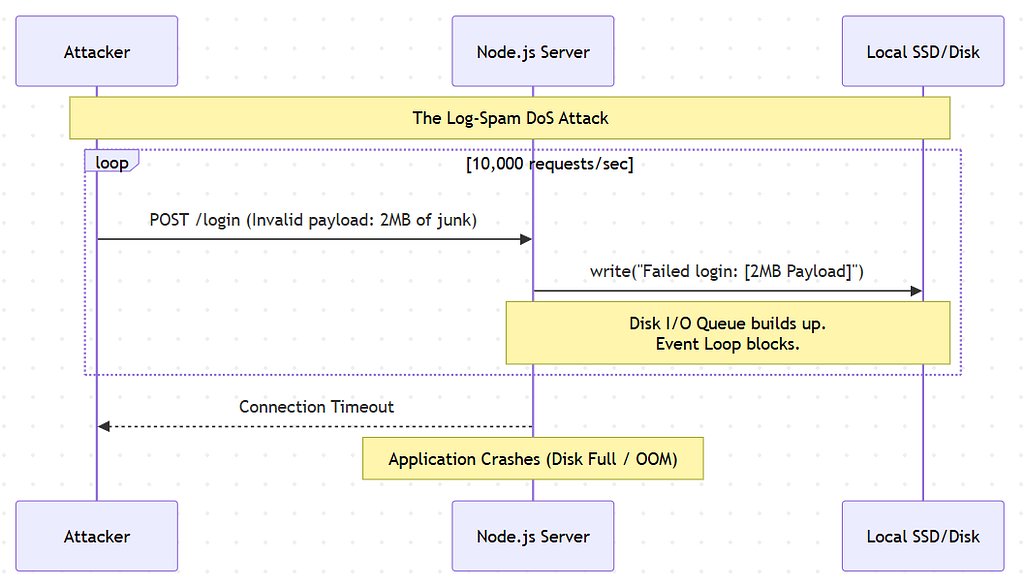
Phase 1: Payload Inflation
The attacker sends highly concurrent requests containing massive, garbage payloads (e.g., a 2MB string in a `User-Agent` header or JSON body).
Phase 2: I/O Blocking & Event Loop Starvation
The application, acting as a “good citizen”, attempts to log the failed request, including the malicious payload. As 10,000 requests per second hit the server, the disk’s Write IOPS are maxed out. The Node.js Event Loop gets starved while waiting for the underlying OS to flush the buffer to the disk. Legitimate users experience massive latency or timeouts.
Phase 3: Disk Exhaustion
Within minutes, the 20GB cloud instance disk is entirely filled with gigabytes of garbage logs. The OS panics, database connections drop, and the server undergoes a hard crash.
The Defense: Asynchronous Observability with ELK
To neutralize this threat, we must decouple the act of generating a log from the act of storing it. This is where the ELK Stack (Elasticsearch, Logstash/Log-forwarder, Kibana) combined with asynchronous batching comes into play.
Instead of writing to the local disk, the Node.js application holds logs in a lightweight, in-memory buffer and transmits them to an isolated Elasticsearch cluster in batches via non-blocking HTTP requests.
The Defensive Architecture
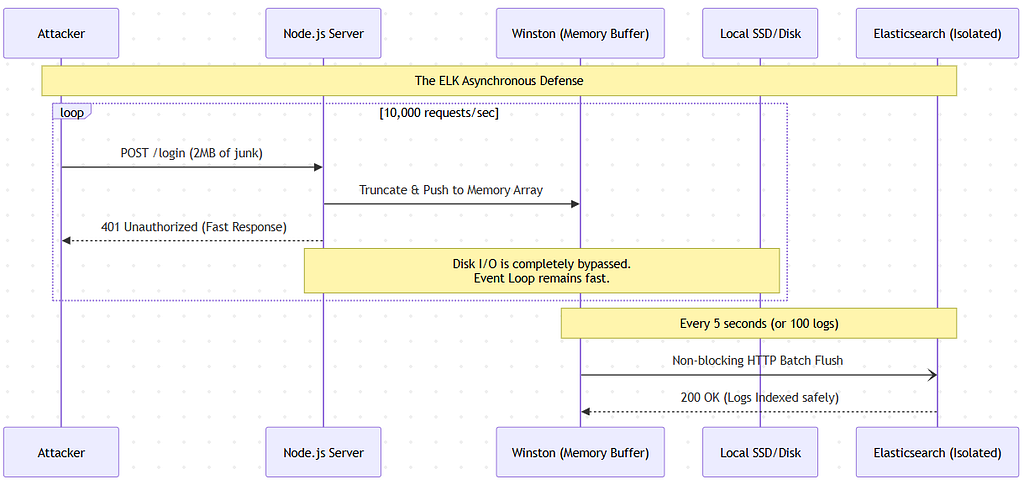
How This Neutralizes the Attack:
1. Zero Disk I/O on the App Server: Logs are never written to the local disk of the Node.js server. The threat of Disk Exhaustion taking down the core API is completely eliminated.
2. Event Loop Protection via Batching By using an integration like winston-elasticsearch, logs are buffered in memory and flushed periodically (e.g., every 100 logs or 5 seconds). The Event Loop is never blocked by OS-level file write operations.
3. Log Truncation & Sanitization: Before hitting the buffer, the logger can be configured to strictly truncate payloads to 500 characters, destroying the attacker’s “Payload Inflation” strategy.
4. Isolated Failure Domains: If the Elasticsearch cluster goes down under the weight of the logs, the Node.js application simply drops the logs (fail-open) and continues serving legitimate users. The application survives.
Conclusion
Logging is essential for security forensics, but architecting it poorly hands attackers a free Denial of Service vector. In enterprise Microservices, centralizing logs via an asynchronous ELK stack is not just about “better searchability” — it is a fundamental defensive mechanism to protect your application’s availability.
Stop writing logs to local disks. Start streaming them asynchronously
Build It Yourself
Setting up an asynchronous ELK integration with Winston, Docker-Compose, and secure networking from scratch can take days of configuration.
If you want to scaffold a production-ready, security-hardened Node.js architecture that implements this exact ELK defensive pattern out-of-the-box, check out the open-source Node.js Quickstart Generator.
By running npx nodejs-quickstart-structure@latest init and selecting the ELK Stack Observability option, you get an architecture designed to survive precisely these kinds of systemic attacks.
Weaponizing Logs: How Attackers Crash Apps via Synchronous Logging (And How ELK Fixes It) was originally published in System Weakness on Medium, where people are continuing the conversation by highlighting and responding to this story.