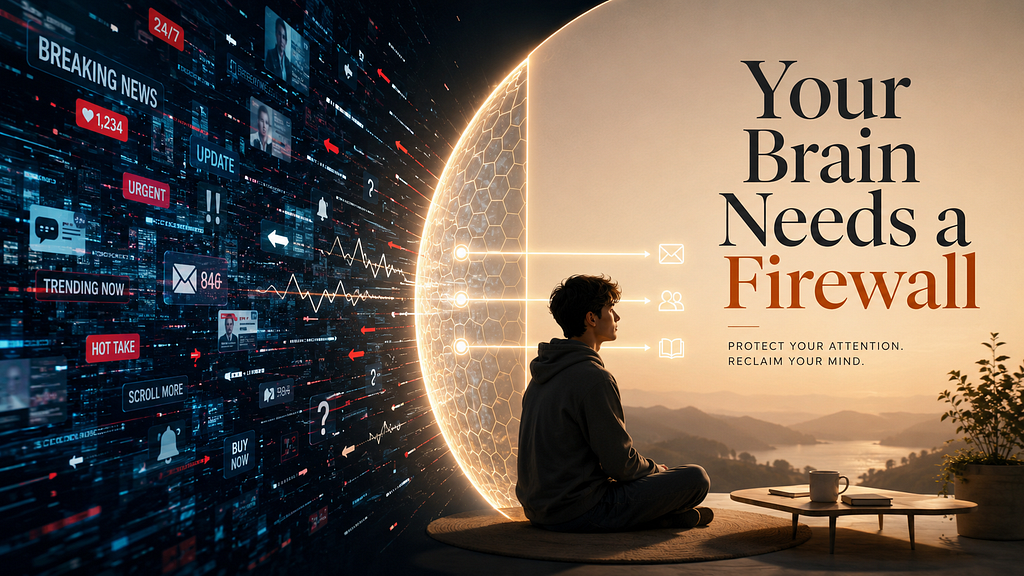
Since I stopped consuming news, television, and most online media, my life has changed.
Not because the world became better.
Because it no longer happens inside me without a filter.
My mood is more stable. My motivation is clearer. My head is quieter. I do not have less reality in my life. I have less borrowed agitation in my nervous system.
That was the moment I understood something simple:
The problem is not only information.
The problem is access.
No production system would be exposed to the public internet without rules. No server runs safely without configuration. No network administrator would say: let everything in, maybe something important is inside.
But that is often how we treat our minds.
Every push notification is allowed in. Every conflict. Every headline. Every opinion. Every crisis. Every scandal. Every video. Every comment. Every stranger’s fear. Every stranger’s anger.
We call that being informed.
Maybe sometimes it is just a badly configured port.
I no longer use the internet as an environment
I have reduced my online input signals to a minimum.
Not because I reject the internet.
Because I noticed what happens when it stays open all the time.
I now use online media more like a tool. I go in when I need something. I do not live there.
The most important rule is simple: no scrolling.
Scrolling is not reading. Scrolling is an open input channel. The system decides what comes next, not me.
I now treat online time almost like a child’s computer time: one hour, then it is over. Not because I want to patronize myself. Because unlimited access is not automatically freedom.
Sometimes a boundary is what makes freedom possible again.
I turned an open stream back into a bounded request.
We live under signal fire
A person in a large city does not simply live in an environment.
They live in a signal space.
Sirens. Advertising. Traffic. Voices. Displays. Messages. Deadlines. Expectations. Politics. Prices. Conflicts. Work. Group chats. Social media. Comment sections. Weather alerts. Crisis updates. Opinion. Counter-opinion. Analysis. Reaction. Reaction to the reaction.
And then there are the internal signals.
Fear. Hope. Ego. Desire. Memory. Experience. Pride. Hurt. Longing. Opinion. The need for control. The need for meaning.
Not all signals come from outside.
Some of the loudest signals start inside us.
That is what makes filtering difficult. We do not filter with a neutral device. We filter with a body that can be tired. With a brain that looks for patterns. With an ego that wants to be right. With a history that makes some signals louder than others.
That is why wanting “better information” is not enough.
We need better rules for what is allowed to enter us at all.
The firewall is already there
Actually, every human being already has a firewall.
We just call it something else.
Judgment. Intuition. Experience. Skepticism. Taste. Boundary. Gut feeling. Attention. Conscience.
Every person constantly decides what to believe, what to ignore, what to react to, and what to pass on. Nobody receives the world unfiltered.
The problem is not that we lack a filter.
The problem is that many people no longer use that filter consciously.
Sometimes we outsource it.
To platforms. To push notifications. To trends. To comment sections. To groups. To political camps. To people who sound louder than they are clear. To algorithms that do not know what is good for us, only what keeps us there.
Then our inner boundary no longer decides what matters.
The system that has learned to bypass that boundary decides.
Most people do not have a broken firewall.
They have a firewall in managed mode.
Other systems write the rules: feeds, groups, media, trends, political outrage, old wounds, old hopes, fear of exclusion.
Then it is not only information that enters.
Prioritization enters.
Someone else decides what feels urgent.
Building a mental firewall does not mean becoming cold. It means taking back responsibility for your own input.
The firewall was never gone.
We only stopped writing its rules ourselves.
Not every signal deserves processing
In software, we classify logs by severity.
Not every log line is an emergency.
Debug is not Emergency. Info is not Critical. Warning is not automatically Alert. The official PSR-3 Logger Interface Standard defines eight levels: debug, info, notice, warning, error, critical, alert, and emergency.
A good system knows what it may ignore.
A bad system treats everything as an alarm.
Humans make the same mistake.
A headline sounds like Warning. A comment sounds like Error. A political fight sounds like Critical. A live ticker sounds like Alert. A push notification sounds like Emergency.
But many things do not affect us directly. Others are true, but not important right now. Some are important, but give us no path to act. And some are designed mostly to feel important.
The problem with modern media is not only the volume of signals.
The problem is that almost everything sounds like an alarm.
By signal, I do not mean anything mystical.
I mean any stimulus that demands attention: a message, a headline, a comment, a video, a piece of information, a dataset, a rumor, a post, an image, a push notification, or even the thought that all of this triggers inside us.
A mental firewall would have to do one thing first: distinguish urgency.
Debug: interesting, but irrelevant.
Info: good to know.
Notice: check later.
Warning: affects me indirectly.
Error: affects my responsibility or planning.
Critical: requires concrete action.
Alert: check immediately.
Emergency: act now.
When everything is Emergency, eventually nothing is Emergency.
The human being does not become more informed.
They become numb.
One signal can change the world. Millions can say nothing.
Sometimes one signal is enough.
A sentence changes a relationship. A measurement changes a theory. A log entry explains a production outage. A phone call prevents a disaster. An image changes a political movement. A real warning signal saves lives.
But more signals do not automatically say more.
Many small waves may do no damage. A flood can.
Many small speakers do not automatically create the effect of one clear, powerful signal. They can also just create noise.
Millions of irrelevant logs can make a system unusable. Not because every single log is dangerous, but because they destroy the attention needed for the one important signal.
The same is true for news.
A thousand comments can contain less insight than one good analysis.
A hundred updates can help less than one clear summary.
An hour of reactions can create less understanding of the world than five minutes of real context.
Information is not valuable because it exists.
It is valuable when it is relevant, reliable, understandable, and actionable.
The second event
An accident happens.
That is the first event.
Then a second event often begins: its digital repetition.
The first report. The push notification. The live ticker. The speculation. The counter-report. The comment. The comment on the comment. The question of blame. The political framing. The outrage. The counter-outrage. The reaction video. The fact-check. The correction. The memory of the false version. The new debate about who said what too early.
The real suffering has not become smaller.
But now millions of additional minutes of attention are being burned.
Compassion is human.
Endless signal extraction is something else.
Of course disasters have to be reported. Of course society needs public information. Of course there are events where looking away would be cowardice.
But there is a difference between looking and consuming endlessly.
There is a difference between responsibility and arousal.
There is a difference between knowledge and repetition.
A study after the Boston Marathon bombings found that repeated media exposure was associated with acute stress; in the studied sample, high media exposure was even more strongly associated with acute stress than direct exposure to the event. That does not mean reporting is wrong. It shows that the second event can become physically effective by itself. The study is here: Media’s role in broadcasting acute stress following the Boston Marathon bombings.
Many digital events have a second wave that no longer serves the original event.
It serves the system that needs attention.
And it often follows us even when we are no longer looking for it.
You read a factual summary and want to move on. Then the same story appears again: on the same page in a new tile, in the next feed, in another account, as an update, as a comment, as a screenshot, as a reaction, as “what we know so far,” as “how the internet is reacting.”
It is no longer an event.
It is a recurring signal in a new layout.
And sometimes cat videos are not harmless either.
They can also create a signal cascade: watching, sharing, commenting, reacting, arguing, comparing, scrolling further. The content is lighter. The structure remains similar.
A system does not have to be evil to consume energy.
It only has to deliver the next signal.
Why bad news goes so deep
I do not believe news automatically makes people worse.
That would be too simple.
But I do believe that constant exposure to threatening, outraging, and disempowering signals can shift a person.
Not all at once.
Slowly.
They become more suspicious. More irritated. More tired. More cynical. Poorer in their sense of the world. Not necessarily because they know more, but because their inner signal space is increasingly filled with danger.
Negative signals often have an advantage. We react to danger faster than to calm. That makes biological sense. Ignoring threats can be dangerous.
But modern media can exploit this old mechanism, even if no individual actor intends harm.
A large cross-national study in PNAS examined psychophysiological reactions to real video news stories in 17 countries and found, on average, stronger reactions to negative news content, while also showing substantial individual variation. The study is called Cross-national evidence of a negativity bias in psychophysiological reactions to news.
A body that receives world crisis every day but has almost no way to act does not automatically learn responsibility.
It learns helplessness.
A signal without an action path is often not knowledge for the nervous system.
It is load.
The world is not only getting worse. Access is getting more direct.
This part has to be fair.
It would be too easy to say: media are bad.
Many news stories matter. Many journalists do necessary work. Without public reporting, there would be less accountability, less investigation, less protection against abuse of power.
The problem is not that bad news exists.
The problem is that bad, urgent, speculative, repeated, and emotionally loaded signals can now be fired directly into the body.
A newspaper used to be an object. You picked it up. You opened it. You put it down.
Today, news is no longer just an object.
It is an environment.
It comes as a push. As a clip. As a comment. As a screenshot. As a meme. As a messenger message. As an outraged thread. As a friend’s reaction. As an algorithmic suggestion that does not ask whether now is a good moment.
The Reuters Institute has been describing growing news avoidance for years. In the Digital News Report 2025, it becomes visible that many people selectively avoid news. That is not only ignorance. It is often self-protection.
But it is also a warning sign.
If more and more people avoid news, the problem is not only the audience.
It is also the signal architecture.
The firewall does not end at the input
A mental firewall does not only decide what may enter me.
It also decides what goes back out through me.
That is the part we often forget.
A comment makes me angry. A headline makes me anxious. A message makes me suspicious. A political conflict hits my own history, my ego, my hope, my hurt, my tiredness.
Then something important happens.
I can simply pass the signal on.
Sharper. Louder. More personal. More toxic.
Or I can slow it down.
I can check what is true. I can check what is only my reaction. I can wait a night. I can ask a question instead of attacking. I can choose not to share something. I can formulate bad news in a way that informs without spreading panic.
That is not suppression.
That is signal processing.
In my article Two Bodies, Many Rhythms, I wrote about sleep, proximity, touch, and the way human beings can calm or activate one another. The same idea belongs here: humans are not neutral cables. We receive signals, transform them, and pass them on in a changed form.
What happens between two people in a bedroom happens on the internet at scale.
One person brings unrest. The other can absorb it and amplify it. Or they can dampen it. A hand on the back, a calm sentence, a slower reply — sometimes that changes the whole room.
Online, that damping is often missing.
The signal does not meet a calm body. It meets an interface, a feed, a comment section, an algorithm, and an audience. A stimulus becomes a reaction. A reaction becomes a counter-reaction. A counter-reaction becomes a trend.
The task is not to call every negative signal positive. Some negative signals matter. Pain is a signal. Criticism is a signal. Danger is a signal. A bug report is a signal.
The task is to avoid turning negative signals into negative outputs without examination.
We can receive signals, evaluate them, reframe them, and pass them on differently.
That may be one of the most important human abilities in the signal age.
Detox is a reset. Firewall is architecture.
Digital detox matters. For me, it was more than an experiment. It was a reset.
Only when I consumed less news, less television, and less online media did I notice how loud it had been before.
But complete withdrawal is not possible for everyone. And perhaps it is not always desirable.
We do not live outside the world. We have responsibilities. We need to know what affects us. We need to remain capable of action. Sometimes we need to receive warning signals.
That is why detox alone is not enough.
Detox is a pause.
Firewall is a structure.
A systematic literature review on digital detox describes digital detox interventions as voluntary timeouts from electronic devices or specific forms of use. The results are mixed and depend strongly on what is reduced, for how long, and for whom. That is exactly why firewall is a stronger model than blanket abstinence. The review is here: Digital detox: An effective solution in the smartphone era?.
A more recent meta-analysis on social media abstinence found no significant effects on positive affect, negative affect, or life satisfaction. That also fits the firewall idea: leaving things out is not always the solution by itself. What matters is which channels, which frequencies, and which usage patterns shape the system. The study is here: The effects of social media abstinence on affective well-being and life satisfaction.
A firewall does not block everything.
It decides.
It closes ports. It limits frequency. It allows some sources through. It blocks others. It puts packets into quarantine. It logs attacks. It distinguishes normal noise from real emergencies.
Attention could be handled the same way.
Do not let everything in.
Do not react immediately.
Do not treat every source the same.
Do not believe every claim of urgency.
Do not read every comment.
Do not consume the same event ten times.
Do not pass every signal on in the same form.
A mental firewall does not make you uninformed.
It prevents every outside system from getting root access to your attention.
My News Signal Audit
I do not simply want to claim that news is mostly negative.
I want to measure it.
That is why my next small data project would be a News Signal Audit.
The idea: observe thirty international news sources over a defined period and classify their signals in a way that is more precise than “good” or “bad.”
That would be too crude.
A report about war can be negative and still necessary.
A positive post can be pleasant and still worthless.
I would measure differently:
What is the signal’s valence: positive, neutral, negative, mixed?
What urgency does it create?
Is there an action path?
Is it locally, nationally, globally, or personally relevant?
Is it new, or only an update without new information?
Which emotion is likely being addressed: fear, anger, disgust, hope, clarity, competence?
How high are the attention costs?
In the end, one could build something like:
Signal value = relevance × reliability × actionability / attention costs
That would not be perfect.
But it would be better than a gut feeling.
There are real data sources for such a project. GDELT describes itself as a near real-time global graph of human society as seen through worldwide news media. Media Cloud is an open-source project for studying global news and information flows.
Maybe the result would be more nuanced than I expect.
Maybe news is not simply too negative. Maybe it is too frequent, too urgent, too repetitive, too context-poor, and too rarely connected to a path for action.
That would be the more interesting thesis anyway.
Rules for a mental firewall
I do not have a perfect solution.
But I do have rules that have made my life quieter.
1. Reduce input signals to the minimum
I no longer open online channels automatically.
I go in when I need something. Then I leave.
That sounds simple. But it is a big difference. A tool is opened for a purpose. An environment surrounds me even when I no longer have a purpose.
This is where I set the rule myself again. Not the feed. Not the push notification. Not the trending topic.
Example: I open a platform to answer a message, publish a post, or research something specific. When that purpose is done, I close it again.
Example: I do not scroll “just for a moment.” Scrolling means the system decides which signal is allowed to enter me next.
2. Push off, pull on
News should not shoot into the day.
I can open it actively when I am ready.
Push means: an outside system decides when it may intervene in my state.
Pull means: I decide when to open a channel.
Example: A breaking-news app should not place a crisis in my head at 7:12 in the morning before I even know how I feel.
Example: Weather warnings, bank notifications, or direct messages from important people may stay. Political outrage, celebrity news, and live tickers can wait.
3. No news in the morning or at night
In the morning, my mind is still shapeable.
At night, my body should find its way out of the day.
Both are bad moments for borrowed agitation.
A day should not begin with a world crisis and end in a comment section.
Example: No phone with news in bed. Not “just a quick look.” That is often the open port.
Example: If news is necessary, use a fixed window around midday or early evening. Not as the first signal of the day and not as the last signal of the night.
4. One story, one source — then close the repetition channels
For many events, one good source is enough.
The real problem often begins afterward: the same information appears again and again in slightly different form. Not because there is real new insight, but because the system can extract new attention from the same event.
Repetition disguises itself as novelty.
Example: An accident happens. I read a factual summary. After that, I avoid live tickers, comment sections, reaction videos, and social media searches about it. Not out of coldness, but because repetition does not reduce the original harm.
Example: I read an article on a news site. After that, I do not keep scrolling through the “more on this” boxes, because they often return the same agitation in a new layout.
Example: If the same story appears in three different accounts, it is not three times more relevant. It has entered my system three times.
5. Check the action path
Not every piece of information deserves immediate processing.
The question is not only: is this true?
The question is also: can I do something with it, decide better because of it, or act more responsibly?
A truth without timing, context, and an action path can still be a burden.
If I cannot find an action path, but I am still being pushed to react strongly, that is a clue: perhaps this signal does not want to inform me. It wants to steer me.
Example: A local warning about icy roads has an action path. I can leave earlier, drive more slowly, or reschedule something.
Example: A global scandal headline without context, without new information, and without any possible action may not have an action path. It creates anger, but not better action.
Example: A dataset about my work, my health, or my city may be relevant. A speculative headline about a topic I can neither verify nor influence does not need to enter my mind immediately.
6. Quarantine stimuli that raise your internal state
Some information does not stay in the head.
It enters the body.
You notice it when you scroll faster, want to answer immediately, start arguing internally, become angry, tense up, or search for more updates.
That is the moment many people think they need to react.
Most of the time, it is the moment they should wait.
Example: A comment makes me angry. I do not reply directly underneath it. I copy the reply into a note and read it again the next day. Usually it becomes clearer whether it should be sent at all.
Example: A headline feels dramatic. I save it and wait for a calmer summary. Many first versions are incomplete, overheated, or later corrected.
Example: If I notice that I am no longer reading but hunting — for confirmation, contradiction, updates, or opponents — I am no longer in information mode. I am in arousal mode.
7. Do not pass every signal on in the same form
Part of the mental firewall is not at the input.
It is at the output.
If a message creates anger, I do not have to become anger. If a comment hits me, I do not have to strike back immediately. If bad news creates fear, I do not have to pass it on as fear.
There is a small space between stimulus and transmission.
That is where I decide whether I become part of escalation or part of damping.
Example: I read bad news and want to send it immediately into a group chat. Instead I ask: am I really informing people — or am I distributing my own unrest?
Example: Someone writes to me in an irritated tone. I can answer in the same tone. Or I can remove the tone and respond only to the factual core.
Example: A political post makes me angry. I do not share it immediately. If it is still important tomorrow, I look for a better source or add context.
A good firewall does not only block attacks.
It also prevents its own system from becoming an amplifier.
8. Treat sources like people
Some sources make me clearer.
Others make me narrower.
Some people are good for me. Others pull me into old patterns.
Why would media be different?
A source is not only a place where information sits. It is a recurring influence on my state.
Example: A source after which I regularly feel irritated, cynical, or helpless gets less access. Not because it is always wrong. Because it is too expensive for my nervous system.
Example: A source that marks uncertainty clearly, corrects errors, and provides context may go on the allowlist.
Example: A source that constantly creates urgency but rarely enables action is no longer an information channel. It is an alarm generator.
9. Actively seek good signals
A firewall is not only defense.
It creates space.
For books. For long analysis. For real conversations. For nature. For work that matters. For music. For quiet. For people who are not constantly broadcasting, but actually present.
If I only remove bad signals, there is emptiness at first.
That emptiness does not have to be filled immediately.
But in the long run, a human being does not only need less junk.
They need better nourishment.
Example: Instead of opening newsfeeds at night, I read a long analysis, a book chapter, or a text that genuinely moves me forward.
Example: Instead of following the same conflict ten times, I call a person, go for a walk, or work on something that concretely improves my life.
Example: Good signals are not always pleasant. Honest criticism can be good. A calm warning can be good. A difficult truth can be good if it creates clarity and enables action.
10. Lower the frequency slowly
A mental firewall does not appear in one day.
At the beginning I had to pay close attention. Which app am I opening? How long am I staying? Am I scrolling again? Am I looking for information or only for the next stimulus?
Later it became easier.
The frequency went down.
What first felt like discipline became ritual. What first felt like deprivation became quiet. At some point the constant stream was no longer missing. It faded like a wave that no longer receives new energy.
At the beginning, a weekly check can help.
Later, a monthly or even quarterly review is enough.
Example: In the first weeks, I check more often: which app pulled me back in? Which source irritated me? Where did I only lose time?
Example: After a few months, a calmer look is enough: which channels may stay? Which have become louder again? Which new habit has slipped in?
The question remains the same:
Which input signals are still allowed to enter my life automatically?
Which rules have I unknowingly handed over to other systems?
And which channels did I only leave open because I had grown used to their noise?
Not less world. Fewer foreign rules.
I do not want less reality.
I want fewer outside systems in my head.
Not every truth has to enter my nervous system at any time.
Not every urgency is my urgency.
Not every opinion needs my energy.
Not every signal deserves processing.
And not every negative signal has to pass through me as a negative signal.
The old task was to find information.
The new task is to reject information without becoming blind.
Anyone who wants to think freely today does not only need knowledge.
They need rules for what is not allowed in.
And responsibility for what goes back out.
Your Brain Needs a Firewall — Why your mind should not be an open port for other people’s systems was originally published in System Weakness on Medium, where people are continuing the conversation by highlighting and responding to this story.